
Oracle EPM snapshots, Hyperion artifacts, Essbase calculation scripts, member formulas, Smart View-style grids, metadata packages, mappings, forms, and reports.
Oracle EPM review
Review Oracle EPM artifacts before release pressure.
EPM Vitals helps Oracle EPM and Hyperion teams turn snapshots, Smart View-style grids, calculation logic, metadata packages, and mappings into proof paths reviewers can inspect.
Related EPM search paths
Terms Oracle EPM and Hyperion teams already use when searching for review evidence.
- #OracleEPMCloud
- #HyperionPlanning
- #Essbase
- #CalculationScripts
- #MemberFormulas
- #SmartView
- #Planning
- #FCCS
- #EPBCS
- #DataManagement
- #FDMEE
- #ImpactAnalysis
Platform review path
Where this fits for Oracle EPM and Hyperion teams.
Use this path when the team needs a shared review record around Oracle EPM delivery work, not another private workbook or meeting-note explanation.
What changed, what is calculated, what may be affected, and what can the team prove before release, migration, or support work moves forward?
Application impact paths, business-readable rule explanation, data validation evidence, metadata findings, readiness workbooks, and reusable review records.
EPM Vitals helps review exported Oracle EPM and Hyperion evidence; it does not replace the platform, the implementation team, or the release approval process.
What teams review
What Oracle EPM teams usually need to review.
Oracle EPM review work usually starts when a team needs confidence before a release, migration, handover, audit, or support transition. The challenge is rarely one missing file. The challenge is that application exports, metadata packages, Smart View-style grids, Essbase or Hyperion calculation logic, mapping files, and readiness notes often live in separate places.
Review the objects people are worried about.
A reviewer may start with a member, form, report, Data Map, Smart List, cube, or dimension. The useful question is not just whether the object exists; it is what that object touches before a release or support decision is made.
Explain calculation scripts and member formulas.
Hyperion and Oracle EPM teams often need to explain Essbase calculation scripts, member formulas, allocation rules, and rule references in language business reviewers can discuss without reading every line of code.
Keep the review record close to the source artifacts.
EPM Vitals helps turn exported files into proof paths so implementation firms, managed service teams, and client-side owners can revisit the same evidence after the meeting ends.
Review questions
Review questions before migration, release, or handover.
What changed in the Oracle EPM application?
Review snapshots, profile evidence, dimensions, members, forms, reports, Data Maps, and related objects so the change can be discussed from a shared record.
How is this account, member, or form calculated?
Use Business Logic Explorer to trace calculation scripts, member formulas, upstream drivers, downstream targets, and rule topology behind the answer.
Are Smart View-style grids and source files aligned?
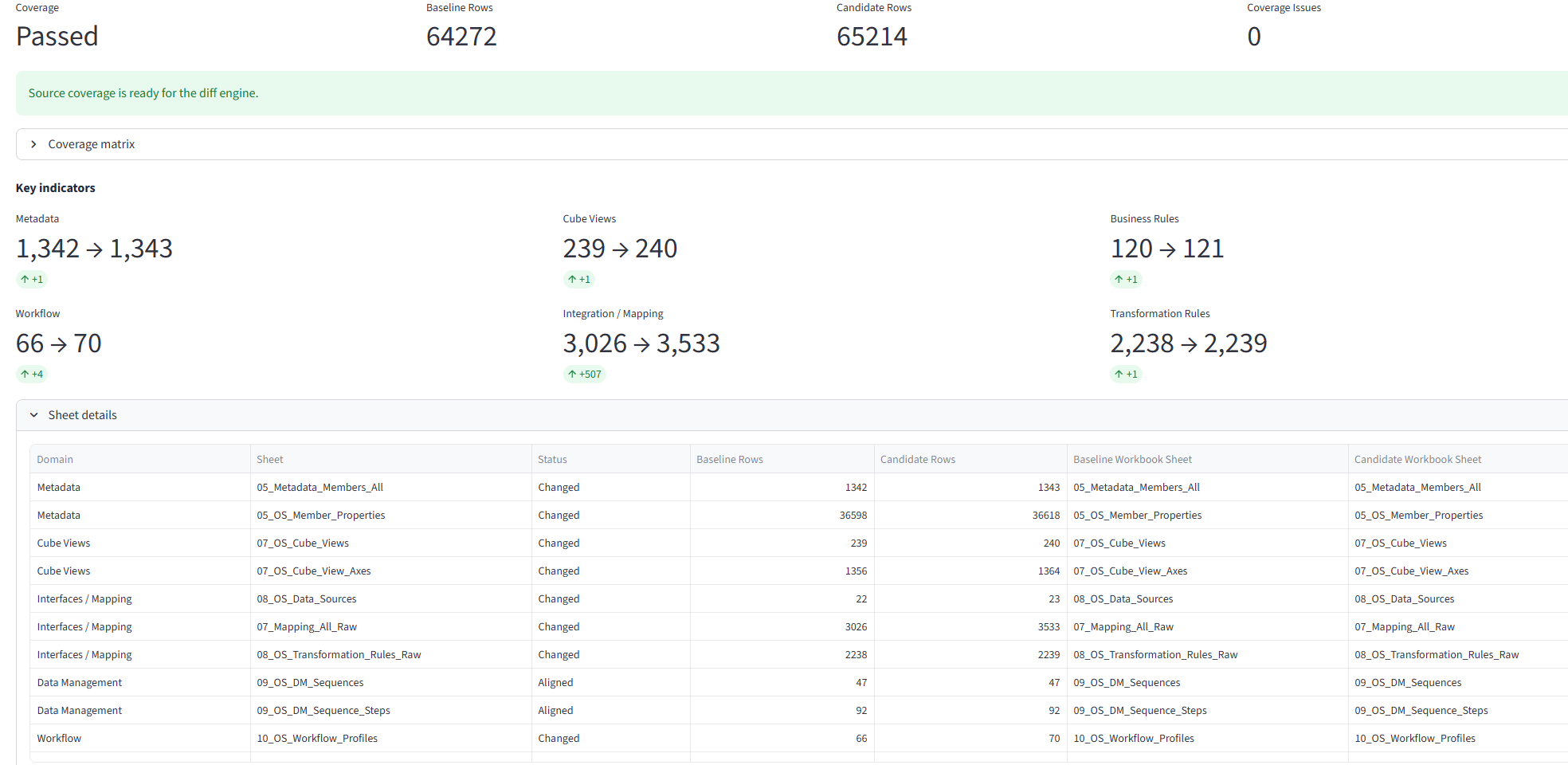
Connect Oracle EPM data readiness to file and grid evidence so reviewers can see differences, row-level support, and reusable validation workbooks.
Can this evidence survive handover?
Move review findings out of private spreadsheets and into a proof path that can be downloaded, revisited, and discussed by the next owner.
Review coverage
How EPM Vitals turns Oracle EPM artifacts into proof paths.
EPM Vitals does not need to pretend every Oracle EPM review is the same. It gives the team separate paths for application impact, business logic, data validation, and metadata review, then keeps those paths connected through the evidence that produced them.
Review area
Typical Oracle EPM evidence
What the team reviews
Business logic
Calculation scripts, member formulas, rule references, FIX and IF context, mounted forms.
How a number is calculated, where the rule applies, and which downstream objects may be touched.
Application impact
Snapshots, forms, reports, Data Maps, Smart Lists, dimensions, members, and related application objects.
Which objects are connected to a change before release, migration, or post-go-live support decisions.
Data and metadata
CSV files, Excel or Smart View-style grids, metadata ZIP packages, mappings, and profile evidence.
Whether files, grids, members, mappings, and package changes are review-ready before downstream pressure arrives.
Boundaries
What this is not.
Clear boundaries matter for Oracle EPM review. EPM Vitals is an evidence and review layer around exported artifacts, not a replacement for Oracle EPM Cloud, Hyperion, Planning, FCCS, PBCS, EPBCS, Essbase, Data Management, FDMEE, or the delivery methodology already used by the team.
Oracle EPM remains the system of record.
EPM Vitals reviews exported evidence and helps teams explain it. It does not run the EPM platform, change security, or replace official Oracle EPM administration.
It supports readiness review, not every migration task.
The page is about review evidence: what changed, what is covered, what is missing, and what should be discussed before migration pressure increases.
It gives the methodology a reusable evidence layer.
Teams can keep their delivery process while using EPM Vitals to make review findings clearer, more repeatable, and easier to hand over.
Related EPM Vitals paths
Start from the part of the Oracle EPM review that carries the most risk.
FAQ
Oracle EPM review questions.
What Oracle EPM artifacts can EPM Vitals review?
EPM Vitals can work with exported evidence such as snapshots, metadata packages, Smart View-style grids, source files, mappings, reports, forms, calculation scripts, and member formulas where those artifacts are provided for review.
Does EPM Vitals replace Oracle EPM or Hyperion?
No. EPM Vitals works around Oracle EPM and Hyperion artifacts to make review, explanation, and reuse clearer for implementation and operations teams.
Can EPM Vitals help before migration, release, or handover?
Yes. It is designed for review moments where teams need to understand what changed, what the change touches, what logic supports the result, and what evidence should be carried into migration, release, handover, audit, or support transition discussions.
What does EPM Vitals help prove during an Oracle EPM review?
It helps teams show the review path from exported artifacts to findings, including application impact, rule explanation, data validation, metadata comparison, and readiness evidence that can be revisited after the original project discussion.
Next step
Book a 20-minute EPM slice demo
Bring one Oracle EPM review question to a demo.
Start with one snapshot, one rule, one grid, one metadata package, or one release question.